
How Automation is Solving the Welding and Palletizing Labor Shortage
The manufacturing and logistics industries are facing a silent crisis. For years, a growing labor shortage has left countless positions for skilled welders and manual material handlers unfilled. The work is physically demanding, requires specific expertise, and often struggles to attract the next generation of workers. This shortage isn’t just an inconvenience; it’s a direct threat to productivity, supply chain stability, and a company’s bottom line.
Fortunately, a powerful solution is not on the horizon—it’s already here. Automation, particularly through robotics, is stepping in to bridge this gap, not by replacing human workers entirely, but by augmenting their capabilities and taking over the most repetitive and strenuous tasks. In this article, we will focus on two critical applications where automation is providing a concrete answer: Welding and Palletizing.
The Scope of the Problem: More Than Just Empty Chairs
Before diving into the solutions, it’s crucial to understand the scale of the problem.
- The Welding Gap: The American Welding Society (AWS) has projected a shortage of over 375,000 welders by 2023, a figure that has likely been realized and continues to grow. This isn’t just about finding warm bodies; it’s about finding skilled craftsmen who can produce consistent, high-quality, and code-compliant welds.
- The Palletizing Problem: In warehouses and distribution centers, the task of palletizing—loading boxes, bags, or cases onto pallets for shipping—is notoriously monotonous and physically taxing. High turnover rates are the norm, and the risk of repetitive strain injuries is significant. During peak seasons or rapid growth periods, scaling a manual palletizing workforce is slow and expensive.
The consequence? Production bottlenecks, delayed orders, increased overtime costs, and quality inconsistencies.
Solution 1: Robotic Welding – Precision, Power, and Consistency
Robotic welding has evolved from a luxury for only the largest automakers to an accessible and vital technology for job shops and mid-sized manufacturers alike.
What Does a Robotic Welding Cell Look Like?
A typical system consists of a multi-axis robotic arm equipped with a welding torch, a work cell that holds the parts to be welded (often with positioners that rotate the part for optimal access), and a sophisticated controller that acts as the brain. The entire process is managed by a human programmer and overseen by a welding operator.
How It Solves the Labor Shortage:
- Amplifying, Not Replacing, Human Skill: A single skilled welder can no longer weld one part at a time. Instead, they can program, supervise, and manage multiple robotic welding cells simultaneously. This one operator can now achieve the output of several manual welders, dramatically increasing productivity per employee.
- Consistency That Never Tires: A robot doesn’t get tired, have an off day, or lose focus. It will repeat the exact same weld path, speed, and parameters millions of times with unwavering precision. This drastically reduces defects, rework, and material waste, ensuring every product that leaves the floor meets the highest quality standards.
- Making Welding More Attractive: By automating the repetitive, overhead, or in uncomfortable positions welds, companies can redeploy their human welders to more complex, custom, and value-added tasks. This makes the welder’s role more of a “tech-supervisor,” which is more appealing to a new generation entering the workforce.
- Faster Throughput and Arc-On Time: Robots can weld much faster than humans and can do so for 23 hours a day if needed. Their “arc-on time” (the percentage of time actually spent welding) can be over 90%, compared to 25-30% for a manual welder who must constantly set up, position, and chip slag.
Tangible Benefits:
- Increased Production Output: Often by 200% or more.
- Superior Weld Quality: Perfect repeatability eliminates human error.
- Reduced Labor Costs: Lower dependency on a large pool of scarce skilled labor.
- Enhanced Safety: Removes the human from direct exposure to fumes, intense arc light, and spatter.
Solution 2: Automated Palletizing – Strength, Speed, and Safety
From food and beverage to consumer goods and pharmaceuticals, automated palletizing is the backbone of the modern distribution center.
What Does an Automated Palletizing System Look Like?
There are two primary types:
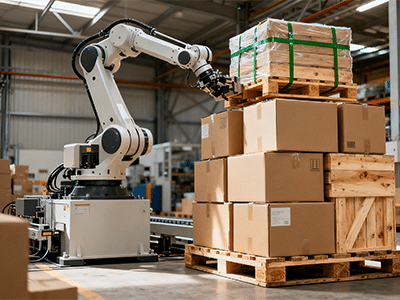
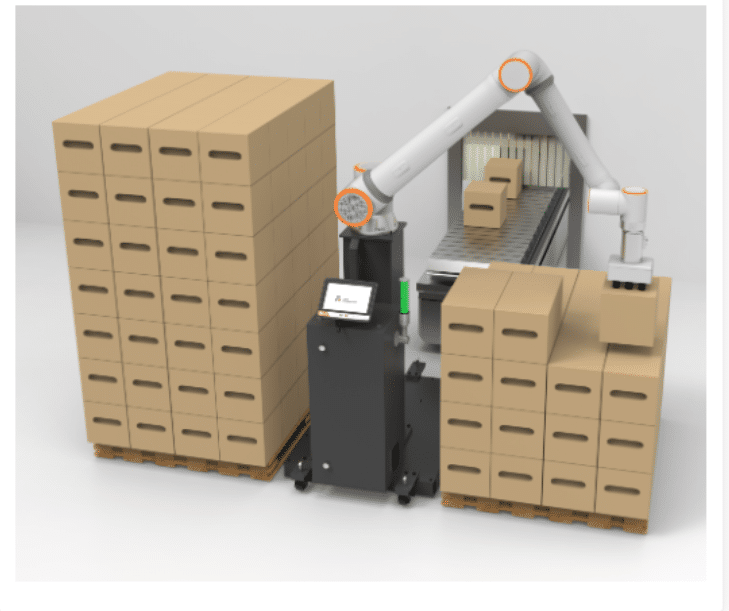
Robotic Palletizers: These use a large, high-payload robotic arm (often a 4-axis or 6-axis robot) equipped with a custom gripper or suction head. The robot picks up items from an incoming conveyor and places them onto a pallet according to a pre-programmed pattern.
Conventional Palletizers: These are machine-specific units that form layers of product and then place the entire layer onto the pallet at once. They are extremely fast for high-volume, uniform products.
How It Solves the Labor Shortage:
- Eliminating the “Back-Breaking” Work: Palletizing heavy bags, awkward cases, or repetitive boxes is a leading cause of workplace injuries. Automation completely removes the physical burden, eliminating strains, sprains, and fatigue. This makes the workplace safer and more attractive.
- Uninterrupted Operation: An automated palletizer doesn’t need lunch breaks, vacations, or shift changes. It can run 24/7, ensuring that shipping deadlines are met consistently, especially during the critical night shifts that are hardest to staff.
- Effortless Scalability: When your business grows, scaling your palletizing capacity is as simple as adding another robot or system. You are no longer constrained by the local labor market’s ability to provide dozens of willing manual laborers.
- Optimized Space and Flow: Automated systems can palletize in tighter spaces and can be integrated into complex conveyor systems, optimizing the entire logistics flow from production line to shipping dock.
Tangible Benefits:
- Massive Productivity Gains: One robot can often replace 2-4 manual palletizing stations.
- Significant Injury Reduction: Drastically lowers worker compensation claims and creates a safer work environment.
- Improved Pallet Integrity and Stability: Robots place items with precise positioning and consistent pressure, creating more stable and secure pallet loads that are less likely to be damaged in transit.
- Flexibility: Modern robotic palletizers can be quickly reprogrammed to handle new products, case sizes, or pallet patterns, providing adaptability in a fast-changing market.
Addressing Common Concerns About Automation
It’s natural to have questions about integrating automation. Let’s address two common ones:
“Is automation too expensive for my business?”
The cost of automation has decreased significantly while its capabilities and ease of use have soared. When viewed as a long-term investment rather than an expense, the Return on Investment (ROI) is compelling. Factor in the savings from reduced labor recruitment, lower injury rates, less scrap, and increased throughput, and most systems pay for themselves in 12-24 months.
“Will robots take all the jobs?”
The data suggests a different story. Automation typically creates as many jobs as it transforms. While manual palletizing or welding roles may decrease, new, higher-skilled positions are created for robot programmers, cell operators, maintenance technicians, and automation engineers. The goal is to let humans do what they do best—problem-solving, innovation, and oversight—while robots handle the dull, dirty, and dangerous tasks.
The Future is Collaborative
The future isn’t about dark, “lights-out” factories run solely by machines. It’s about collaboration. We are now seeing the rise of collaborative robots (cobots) in both welding and palletizing. These cobots are designed to work safely alongside human workers, guided by them to perform tasks. A seasoned welder can physically guide a cobot arm through a weld path, “teaching” it the motion, which the cobot then repeats perfectly. This lowers the barrier to entry and makes automation a tool that empowers, rather than replaces, the human worker.
Conclusion: Embracing the Automated Advantage
The labor shortage in welding and palletizing is a formidable challenge, but it is not insurmountable. Automation provides a proven, efficient, and intelligent pathway forward. By implementing robotic welding and automated palletizing systems, companies are not just solving a staffing crisis—they are unlocking new levels of quality, efficiency, and safety.
The question is no longer if a business should automate, but when and how. In the face of a shrinking workforce, automation is no longer an option; it’s the key to a resilient and competitive future.