
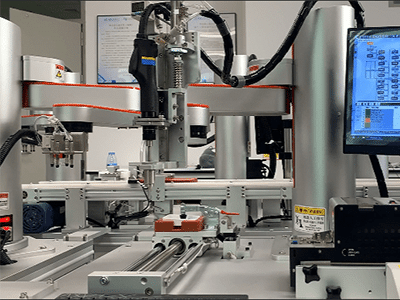
SCARA Robots: The Ultimate Guide to High-Speed Pick and Place & Assembly Automation
In the fast-paced world of manufacturing, precision, speed, and reliability are non-negotiable. Whether you’re assembling intricate electronics, packaging pharmaceuticals, or feeding components into a CNC machine, the repetitive nature of these tasks demands a solution that never tires, never makes a careless error, and works 24/7. Enter the SCARA robots for automatic pick and place – a specialized automation workhorse engineered explicitly for speed and accuracy in a single plane.
If you’re considering automation to boost your productivity, understanding the strengths and applications of the SCARA robot is a crucial first step. This comprehensive guide will break down everything you need to know.
What is a SCARA Robot? Understanding the Basics
SCARA stands for Selective Compliance Assembly Robot Arm. The name itself holds the key to its design philosophy:
Selective Compliance: This means the robot is rigid and stable in the vertical Z-axis (like a human arm pushing down) but is intentionally slightly compliant or “flexible” in the horizontal X-Y plane. This unique feature allows the arm to “give” a little if it encounters a minor misalignment during insertion tasks (like placing a peg in a hole), preventing damage to parts and tools. Once the misalignment is corrected, the arm springs back to its intended position.
Assembly Robot Arm: Clearly stating its primary purpose.
Visually, a SCARA robot resembles a human arm, with two parallel joints that provide movement in the X, Y, and Z coordinates. This design makes it exceptionally fast and precise for tasks within a defined, cylindrical work envelope.
How Does a SCARA Robot Work? The Mechanics of Speed
A typical SCARA robot has four axes of motion:
- Axis 1 (J1): The base rotates the entire arm (shoulder rotation).
- Axis 2 (J2): The second joint controls the elbow’s movement.
- Axis 3 (J3): This is a vertical (Z-axis) motion, allowing the arm to move up and down.
- Axis 4 (J4): This is the wrist rotation, providing rotational control to orient the part or tool.
The magic lies in the synergy of the first two axes. The parallel-link structure allows the motors to work together to move the arm end (the “end-effector”) through its X-Y plane at incredible speeds with minimal vibration. This is far faster than a traditional six-axis articulated robot can achieve for similar lateral movements.
Why Choose a SCARA Robot? Key Advantages for Your Business
When evaluating automation options, the SCARA robot offers a compelling set of benefits for specific applications:
- Blistering Speed and High Throughput: SCARAs are the sprinters of the robot world. Their lightweight arms and direct-drive motors enable accelerations and cycle times that are unmatched by other robot types for pick-and-place tasks. This directly translates to more parts per hour and a higher return on investment (ROI).
- Exceptional Repeatability and Precision: While speed is impressive, it’s useless without accuracy. SCARA robots boast exceptional repeatability, often within microns. This means they can place components on a circuit board or insert a microscopic lens into a camera assembly millions of times with unwavering consistency, drastically reducing scrap and rework.
- Unmatched Reliability and Uptime: Designed for continuous operation in harsh industrial environments, SCARAs are built to last. They require minimal maintenance and can operate 24/7/365, ensuring your production line keeps running and meeting deadlines.
- Space-Efficient Footprint: With a small base and a vertically oriented work envelope, SCARAs take up very valuable factory floor space. They can be mounted on tables, shelves, or even integrated directly into machinery.
- Ease of Integration and Programming: Modern SCARA robots come with intuitive graphical user interfaces (GUIs) and teach pendants. Many support drag-and-drop programming or waypoint teaching, making them easier to set up and deploy than ever before, even for operators without advanced robotics degrees.
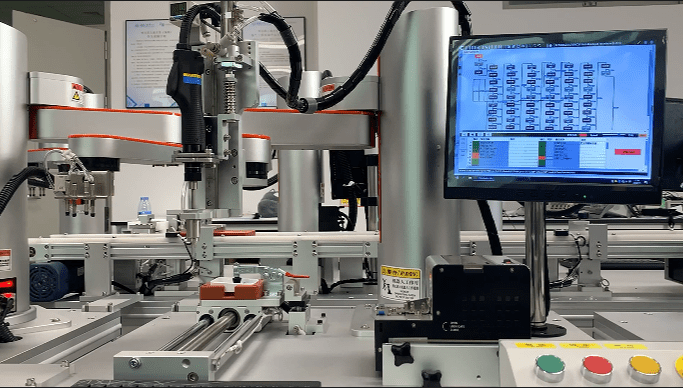
Key Applications: Where SCARA Robots Shine
The combination of speed, precision, and selective compliance makes SCARA robots ideal for a vast range of industries:
- Electronics Manufacturing: The classic application. PCB population (chip placing), soldering, screwdriving, connector insertion, and keyboard assembly.
- Pharmaceutical and Medical Device Assembly: Handling pipettes, assembling drug delivery devices, packaging sterile products, and placing lab samples into trays with gentle precision.
- Plastic Molding and Die-Casting: High-speed part removal from injection molding machines and trimming of flash.
- Food and Beverage Packaging: Pick and place of products into blister packs, boxes, or trays. Palletizing small cases.
- General Manufacturing: Gasket placement, adhesive dispensing, material handling (machine tending), and quality inspection.
SCARA vs. Other Robots: Making the Right Choice
How do you know if a SCARA is right for you? Here’s a quick comparison:
SCARA vs. Cartesian/Gantry Robots: Gantry robots move in three linear (X, Y, Z) axes. They are excellent for very large work areas and heavy payloads but are generally slower and less compact than SCARAs for small to medium-sized workspaces.
SCARA vs. 6-Axis Articulated Robots: The six-axis robot is the versatile all-rounder. It can reach around and over obstacles, making it ideal for complex welding or painting. However, for fast, point-to-point movements in a single plane, the SCARA is almost always faster and more cost-effective.
SCARA vs. Delta Robots: Delta robots are also incredibly fast and are often used for high-speed pick and place of very lightweight items (e.g., chocolates onto a conveyor). However, their work envelope is typically limited to a dome shape below the robot, whereas a SCARA has a broader shoulder-level work envelope and can handle heavier payloads.
Decision Guide: Choose a SCARA if your application is primarily high-speed, precise movement within a defined, horizontal workspace with a vertical component (e.g., pick from here, place there).
What to Consider When Integrating a SCARA Robot
Before investing, consider these factors:
- Payload: What is the maximum weight the robot needs to carry (including the end-effector/gripper)?
- Reach and Work Envelope: Map out the area the robot needs to cover. Ensure the SCARA’s model you choose can reach all necessary points.
- Cycle Time: Calculate your required parts-per-minute to determine the necessary speed.
- Accuracy vs. Repeatability: Understand your need. Do you need absolute precision to a specific coordinate (accuracy), or incredible consistency in returning to a taught point (repeatability)? SCARAs excel at the latter.
- End-Effector: The gripper, vacuum cup, or tooling on the end of the arm is critical. It must be matched to the part’s weight, geometry, and fragility.
- Integration Support: Partner with a supplier that offers strong technical support, training, and integration services to ensure a smooth deployment.
The Future of SCARA Robotics
SCARA technology continues to evolve. Key trends include:
- Collaborative SCARAs (cSCARAs): New designs with force-limited motors, rounded edges, and sensors allow SCARAs to work safely alongside humans without traditional safety cages, opening up new possibilities for hybrid workcells.
- Integrated Vision Systems: Cameras are becoming a standard, affordable option, enabling robots to identify part location, orientation, and perform quality checks on the fly.
- Easier Programming and AI: AI-powered software is simplifying calibration and error recovery, while cloud connectivity enables predictive maintenance and data analytics for optimizing entire production flows.
Conclusion: Is a SCARA Robot the Right Tool for You?
If your business relies on high-mix, high-volume assembly, packaging, or material handling tasks that require superhuman speed and micron-level precision, the answer is likely a resounding yes.
The SCARA Robots for Automatic Pick and Place is not just a piece of machinery; it’s a strategic investment. It empowers you to overcome labor shortages, maintain impeccable quality standards, increase output, and stay competitive in a global market. By automating repetitive and delicate tasks, you free up your skilled human workforce to focus on higher-value operations like oversight, quality control, and innovation.
Ready to explore how a SCARA robot can transform your production line? Contact our automation experts today for a free consultation and discover the perfect solution for your unique application.