
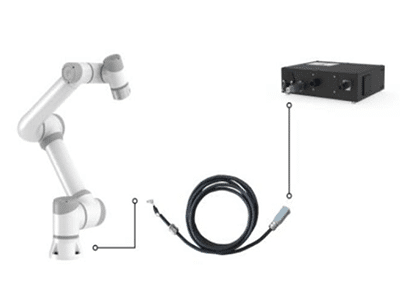
What’s the control principle of collaborative robots?
Forget clunky cages and emergency stop buttons. Collaborative robots (cobots) operate safely alongside humans, revolutionizing factories, labs, and warehouses. But how do they avoid collisions? What magic lets them sense human presence and react instantly? Let’s peel back the layers and explore the fascinating control principle of collaborative robots that make cobots uniquely safe and powerful partners.
Beyond “Just Programming”: The Core Control Principle of Collaborative Robots
Unlike traditional industrial robots designed for speed and isolation, cobots prioritize adaptive safety and intuitive interaction. Their control systems constantly answer three questions in real-time:
- Where is the human? (Perception)
- What is the robot doing? (Motion Planning)
- How should I react? (Safety Response)
This happens hundreds of times per second through a sophisticated blend of hardware and software.
The 4 Pillars of Cobot Control: How Safety is Engineered
Collaborative robots achieve their signature safety through four distinct technical approaches defined by ISO 10218 and ISO/TS 15066 standards. Understanding these principles is critical for selecting the right cobot for your workspace:
- Safety-Rated Emergency Stop
This is the simplest safety approach. When sensors detect a human entering the robot’s predefined workspace, the cobot immediately performs a complete stop. All motion halts until the area is fully cleared and the system receives a manual restart command. While reliable, this principle introduces workflow interruptions – making it best suited for tasks where human intervention is infrequent (e.g., loading raw materials every 30 minutes). Its “hard stop” nature limits true collaborative fluidity.
- Hand Guiding
Here, safety transforms into direct human control. Operators physically grasp the cobot’s arm equipped with embedded force sensors, triggering a “zero-gravity mode” that allows effortless manual positioning. This principle excels in task teaching (like demonstrating screw-driving paths) or precision adjustments in assembly lines. However, it requires constant human interaction and isn’t designed for autonomous operation once programmed.
- Speed & Separation Monitoring (SSM)
SSM enables dynamic co-existence through spatial awareness. Using 3D cameras, LiDAR, or area scanners, the cobot continuously tracks human proximity within its workspace. As a worker approaches:
– The robot progressively slows down (e.g., from 1 m/s to 0.2 m/s)
– If the human breaches a minimum safety distance (typically 200-500mm), it stops entirely
This allows shared workspaces with predictable traffic patterns, like packaging stations. Key limitations include calibration complexity and reduced efficiency in cramped areas.
- Power and Force Limiting (PFL) – The Industry Standard
As the dominant principle in modern cobots (UR, Techman, Fanuc CRX), PFL builds inherent safety into the robot’s core mechanics. Through torque sensors in every joint, back-drivable motors, and real-time force feedback algorithms, the cobot:
– Limits impact forces below ISO thresholds (<150N for body contact)
– Instantly stops upon collision detection
– Allows “bumping” without injury
PFL enables genuine unpredictable collaboration – ideal for tasks like human-robot part handovers or quality inspection in crowded cells. Trade-offs include payload/speed caps and mandatory risk assessments for sharp tools.
Critical Technical Trade-Offs at a Glance
- – Safest Close Contact: PFL (works in direct contact scenarios)
- – Least Workflow Disruption: SSM (slows but rarely stops fully)
- – Fastest Teaching: Hand Guiding (no coding needed)
- – Simplest Integration: Safety-Rated Stop (minimal sensors)
> Real-World Insight: Over 75% of new-generation cobots (2020+) combine PFL with SSM for multi-layered safety – using force limiting for immediate collisions and speed reduction for proximity warnings.
> PFL is the cornerstone of modern cobots like UR, Fanuc CRX, or Yaskawa HC10. Let’s dive deeper into its tech stack.
Motion Control (Core):
- Forward kinematics: Given all joint angles, the precise position and orientation of the end effector are calculated. This is relatively simple and straightforward.
- Inverse kinematics: Given the desired target position and orientation of the end effector, the required six joint angles are calculated. This is the core and most challenging aspect of six-axis robot control. Multiple solutions are often available, and the optimal solution must be selected (considering joint limits, singularity avoidance, and energy minimization). Real-time computational requirements are very high.
- Joint Space Control: The controller (PID control) compares the target joint angle (or velocity, torque) calculated by inverse kinematics with the actual encoder feedback, generating an error signal. Based on this error, the controller calculates the control signal (usually a current command) to be sent to the servo drive, driving the motor to rotate so that the actual joint angle tracks the target value.
- Cartesian Space Control: Sometimes control is performed directly in the end effector’s position/or orientation space (such as impedance control or admittance control), and then the control variable is converted to joint space through inverse kinematics for execution. This is common in force control applications.
Inside Power and Force Limiting (PFL): The Tech Breakdown
- Sensing the Environment (The “Nervous System”)
- – Joint Torque Sensors: Measure force at every motor. Detect unexpected resistance (e.g., hitting an arm).
- – Skin Sensors (Emerging): Pressure-sensitive “skin” on the arm triggers stops on contact.
- – 3D Vision Systems: Cameras/LiDAR map workspace and track human movement (used with SSM).
2. Real-Time Motion Control (The “Brain”)
- – Collision Detection Algorithms: Instantly compare expected motor current/torque with actual values. Deviations = potential collision.
- – Dynamic Path Planning: If an obstacle is detected, the robot recalculates its path while moving to avoid contact.
- – Force Feedback Loops: Continuously adjust motor power to maintain safe contact force (<150N for body, <50N for hands/face per ISO/TS 15066).
3. Safe Actuation (The “Muscles”)
- – Low-Friction Gearboxes: Reduce inherent inertia, enabling quick stops.
- – Back-Drivable Motors: Allow humans to easily push the arm away if needed.
- – Electromagnetic Brakes: Engage instantly on power loss or fault detection.
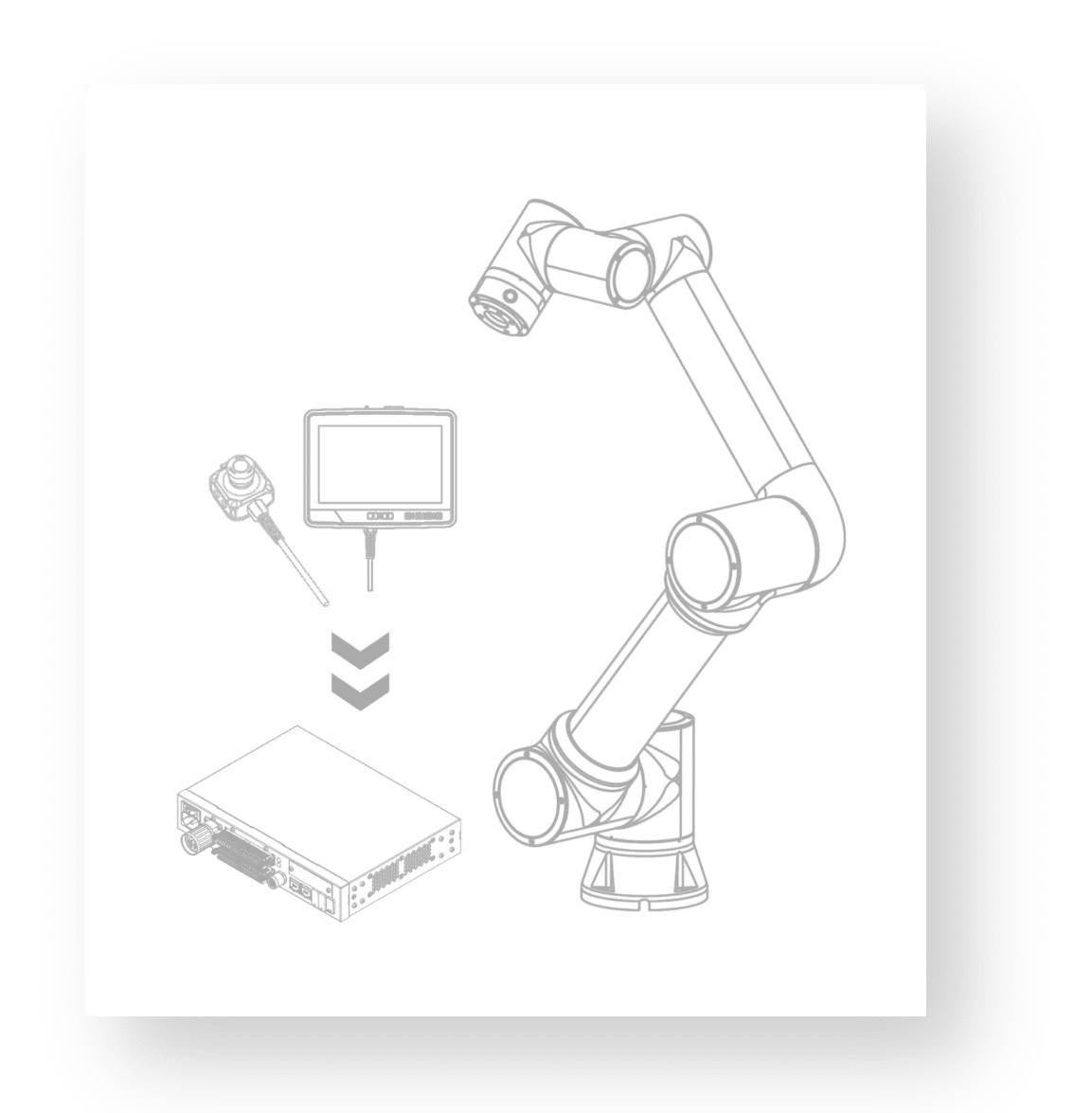
Why Software is the True Game-Changer
Hardware enables safety, but software defines intelligence:
- Intuitive Programming:
– Hand-Guiding: Physically move the arm to teach waypoints (no coding).
– Graphical Interfaces: Drag-and-drop workflow builders (Smart Teach Pendant).
→ Democratizes automation for non-engineers.
- Adaptive Workflows:
– Cobots sense if a part is misaligned and adjust grip.
– They slow down when a worker leans into the shared cell.
→ Enables fluid human-robot teamwork.
- Predictive Safety:
– AI analyzes movement patterns to anticipate collisions before they happen.
– “Virtual Zones” define custom speed/force rules for specific areas.
→ Proactively prevents risky situations.

Beyond Safety: How Control Principles Enable Versatility
The same systems that enable safety also unlock new capabilities:
– Precision Force Control:
Apply exact pressure for polishing, sanding, or inserting delicate components.
Example: Assembling medical devices without damaging plastic parts.
– Tactile Feedback:
Detect grip slippage or part misalignment using force/torque data.
Example: Handling fragile glass vials in pharma packaging.
– Seamless Tool Switching:
Integrated tool control (electric, pneumatic) managed through the same safety interface.
Example: A cobot drills holes, then swaps to a gripper for deburring – all within one cell.
Limitations & Critical Considerations
Cobots aren’t infallible. Smart implementation matters:
⚠️ Payload/Speed Trade-off: Higher payloads require stricter safety margins (slower speeds).
⚠️ Tooling Matters: Sharp or heavy end-effectors increase injury risk – require separate risk assessment.
⚠️ Environmental Factors: Glare, dust, or vibrations can impair vision/force sensors.
⚠️ Human Behavior: Unpredictable movements (running, jumping near the bot) challenge even advanced SSM.
> Golden Rule: Always conduct a task-specific risk assessment per ISO/TS 15066, even with “inherently safe” cobots.
The Future: Next-Gen Control Systems
- AI-Powered Prediction:
Machine learning models forecasting human motion patterns for smoother avoidance.
- Multi-Sensor Fusion:
Combining vision, torque, audio, and thermal data for 360° awareness.
- Adaptive Compliance:
Robots that dynamically adjust stiffness (rigid for tasks, soft for contact).
- Cloud-Based Safety:
Real-time fleet monitoring and remote safety protocol updates.
Why Understanding Control Principles Matters for Your Business
Choosing a cobot isn’t just about payload or reach. Its control architecture determines:
✅ Safety Integrity: How reliably it protects workers.
✅ Ease of Integration: How quickly you deploy it.
✅ ROI Potential: How flexibly it adapts to new tasks.
Implement with Confidence:
- Prioritize cobots with certified PFL + SSM capabilities.
- Validate force/speed limits for your specific tools and tasks.
- Leverage no-code programming to empower shop-floor staff.
Ready to harness safe collaboration? Hitbot’s cobots combine ISO-certified PFL control with intuitive online operating system. Book a Risk-Free Trial to experience responsive, adaptive automation.