
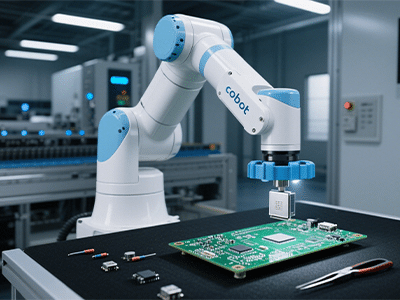
Precision Partners: How Cobots Are Revolutionizing Electronics Assembly
Imagine assembling components smaller than a grain of salt, under a microscope, for 8 hours straight. Now picture a tireless assistant that never blinks, never tires, and positions each microscopic part with 0.01mm accuracy. This isn’t science fiction—it’s today’s reality of cobots for electronics assembly manufacturing, thanks to collaborative robots (cobots). As devices shrink and complexity soars, cobots are becoming essential tools for PCB assembly, testing, and packaging. Let’s explore how these agile machines are transforming the electronics industry.
Cobots are transforming the electronics assembly industry by enhancing efficiency, precision, and flexibility in manufacturing processes. In a sector where components are often small, delicate, and require high levels of accuracy, cobots provide a versatile solution. They work alongside human operators, complementing their skills and reducing physical strain, making them ideal for tasks such as component placement, soldering, testing, and packaging.
⚡ Why Electronics Assembly Needs Cobots
The electronics sector faces unprecedented challenges:
- – Miniaturization Madness: 0201 components (0.6mm x 0.3mm) require superhuman precision
- – ESD Sensitivity: A single electrostatic discharge can destroy $10,000 PCBs
- – Labor-Intensive Processes: 70% of manufacturers report skilled technician shortages
- – Zero-Defect Demands: Automotive/medical electronics tolerate 0% failure rates
- – High-Mix Complexity: Frequent line changeovers for custom configurations
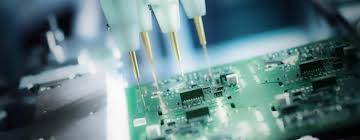
Traditional automation often failed here—too rigid for small batches, too dangerous for human collaboration, and too expensive for SMEs. Cobots bridge this gap perfectly.
Key Benefits of Cobots for Electronics Assembly
1.Increased Efficiency and Speed: Cobots can perform repetitive and tedious tasks with consistent speed and accuracy, allowing human operators to focus on more complex activities. This synergy between cobots and humans can significantly speed up production timelines.
2.Improved Precision: Electronics components are often tiny and require high precision during assembly. Cobots can work with minimal error, ensuring that parts like microchips and connectors are placed correctly and securely.
3.Flexibility and Adaptability: Cobots are easily reprogrammable for different tasks, making them ideal for industries that need quick adaptation to changing product designs or production volumes. This flexibility is essential in the electronics industry, where new product lines are regularly introduced.
4.Cost-Effective Solution: By automating repetitive tasks, cobots reduce the risk of human error, which can lead to costly rework or defects. Additionally, cobots typically have a lower upfront cost compared to traditional robots and require less maintenance, making them an attractive investment for small to medium-sized businesses.
🛠️ 5 Game-Changing Cobot Applications in Electronics
1️⃣ Micro-Precision Component Placement
– Cobot Advantage:
- – ±0.01mm repeatability with force sensing (prevents cracked ceramics)
- – Vacuum EOAT with conductive tips (ESD-safe handling)
- – 50% faster than manual placement for QFN/DFN packages
– Use Cases:
- – SMD chip placement
- – Connector/pin header insertion
- – Flex PCB assembly
2️⃣ Delicate Soldering & Dispensing
– Cobot Advantage:
- – 0.1mm accuracy for solder paste dispensing
- – Thermal cameras monitor joint quality in real-time
- – Works alongside human operators in confined spaces
– Use Cases:
- – Reworking BGA chips
- – Underfill epoxy application
- – Selective soldering
3️⃣ Automated Optical Inspection (AOI)
– Cobot Advantage:
- – 6-axis positioning for oblique angle inspections
- – AI defect detection (tombstoning, bridging, skew)
- – 100% inspection coverage vs. human sampling
– Metrics:
- – 99.98% defect detection rate
- – 3x faster than manual inspection
4️⃣ Functional Testing & Burn-In
– Cobot Advantage:
- – Precise probe positioning for micro-test points
- – Consistent 24/7 endurance testing
- – Automated pass/fail logging (traceable to ISO 9001)
– Applications:
- – ICT (In-Circuit Testing)
- – FCT (Functional Circuit Testing)
- – Thermal cycling validation
5️⃣ Packaging & Kitting
- – Cobot Advantage:
- – Gentle handling of fragile boards
- – ESD-safe grippers with <10V discharge
- – Seamless barcode scanning/tracking
⚡ Why Cobots Outperform Traditional Automation in Electronics
| Deployment Time | Changeover Speed | Space Requirement | ESD Safety | Micro-Precision | |
|---|---|---|---|---|---|
| Industrial Robots | 8-12 weeks | Hours (requires programmer) | 10m²+ with fencing | Custom modification needed | Overkill for most tasks |
| Cobots | 2-4 days | Minutes (hand-guided teaching) | Benchtop installation | Native ESD variants available | Perfect for sub-millimeter work |
🔌 Critical Technical Considerations
- ESD Protection Systems
– Must-Have Features:
- – Conductive anodized aluminum (surface resistance 10⁴-10⁶ Ω)
- – Continuous monitoring (<100V discharge threshold)
- – Ionized air blowers integrated in EOAT
- Specialized End Effectors
| Component Placement | Connector Insertion | PCB Handling | |
|---|---|---|---|
| Recommended EOAT | Vacuum tool with 0.3mm nozzles | Self-centering jaws | Edge-grippers with PCB grooves |
| Precision | ±0.01mm | 0.05N force control | Zero board flex |
- Machine Vision Integration
- – 2D Vision: Barcode reading, component presence checks
- – 3D Vision: Solder paste volume measurement, coplanarity checks
- – AI Defect Detection: Train systems with defect image libraries
📈 Quantifiable Benefits for Electronics Manufacturers
Case Study: Automotive ECU Producer
| Pre-Cobot | With Cobot | Improvement | |
|---|---|---|---|
| Placement Defects | 1,200 ppm | 18 ppm | 98.5% ↓ |
| Changeover Time | 45 minutes | 7 minutes | 84% ↓ |
| ESD Failures | 3.1% of boards | 0.2% of boards | 94% ↓ |
| Labor Cost | $38/unit | $21/unit | 45% ↓ |
🚀 Implementation Roadmap
Phase 1: Task Identification (Start Here)
A[High-Error Tasks] –> B[Repetitive Processes]
C[ESD-Sensitive Steps] –> D[Bottleneck Operations]
A+B+C+D –> E[Ideal Cobot Candidate]
Phase 2: Cobot Selection Guide
| Payload | Repeatability | ESD-Safe | Best For | |
|---|---|---|---|---|
| Universal Robots UR5e | 5kg | ±0.03mm | Yes | PCB handling/testing |
| Techman TM5S-900 | 4kg | ±0.02mm | Yes | Micro-component place |
| FANUC CRX-10iA | 10kg | ±0.03mm | Optional | Heavy fixture tending |
Phase 3: Validation Protocol
- ESD Certification: ANSI/ESD S20.20 compliance audit
- Process Validation: GR&R (Gauge R&R) < 10%
- Traceability Setup: MES integration for component-level tracking
🔮 Future Trends to Watch
- AI-Powered Self-Correction: Cobots adjusting solder paste volume based on thermal imaging
- Swarm Assembly: Multiple cobots collaborating on complex PCBs (e.g., 1 places components while another solders)
- Quantum Tunneling Microscopy Integration: Real-time atomic-level solder joint inspection
- Self-Charging Cobots: Automatic docking at wireless charging stations
✅ Why Now is the Time to Adopt
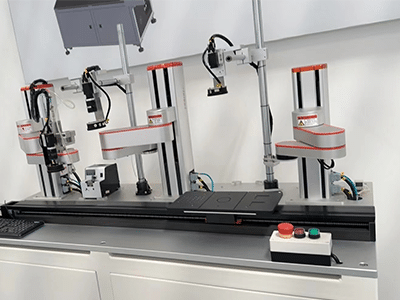
- – Component Shrinkage: 01005 components (0.4mm x 0.2mm) demand automation
- – Labor Crisis: Electronics technicians shortage up 38% since 2020
- – Regulatory Pressure: IPC-A-610 Class 3 requires zero visible defects
- – Competitive Edge: Early adopters report 20-35% lower assembly costs
Common User Concerns and Solutions
1.Are cobots safe to work with?
Cobots are specifically designed to work alongside humans, and they come equipped with safety sensors that prevent them from causing harm. For example, if a cobot detects an obstruction or if it comes into contact with a human, it will automatically slow down or stop. This ensures a safe working environment.
2.Do cobots require specialized training to use?
While cobots are designed to be user-friendly, some level of training is required, especially for programming and troubleshooting. However, many cobots come with intuitive interfaces and easy-to-follow instructions, making them accessible even to users without an extensive background in robotics.
3.How do cobots integrate with existing assembly lines?
Cobots are highly adaptable and can be seamlessly integrated into existing production lines. They can work alongside current machinery and be programmed to perform specific tasks, making them a flexible addition to any production environment.
Conclusion
The use of cobots in electronics assembly represents a significant advancement in manufacturing technology. These robots not only boost efficiency and precision but also improve safety and adaptability in the workplace. As the electronics industry continues to evolve, cobots are becoming an indispensable tool for businesses aiming to remain competitive and deliver high-quality products. By addressing common concerns and showcasing their versatility, cobots prove to be a valuable investment for modern electronics assembly.