
What’s the control principle of scara robot?
The Precision Dance: Demystifying SCARA Robot Control Principles for Peak Performance
SCARA robots (Selective Compliance Assembly Robot Arm) are ubiquitous workhorses in modern manufacturing. Their signature speed, precision in the horizontal plane, and relatively compact footprint make them ideal for tasks like high-speed assembly, pick-and-place, material handling, and intricate inspection – especially in the electronics, automotive, medical device, and consumer goods sectors. But what truly makes these mechanical arms move with such astonishing accuracy and repeatability? The answer lies in a sophisticated interplay of mechanics, mathematics, and real-time electronics – the control principle of SCARA robots. Understanding these principles isn’t just technical trivia; it empowers you to select, optimize, and troubleshoot these robots effectively, maximizing your production line’s efficiency and quality.
-
The Mechanical Foundation: Built for Planar Precision
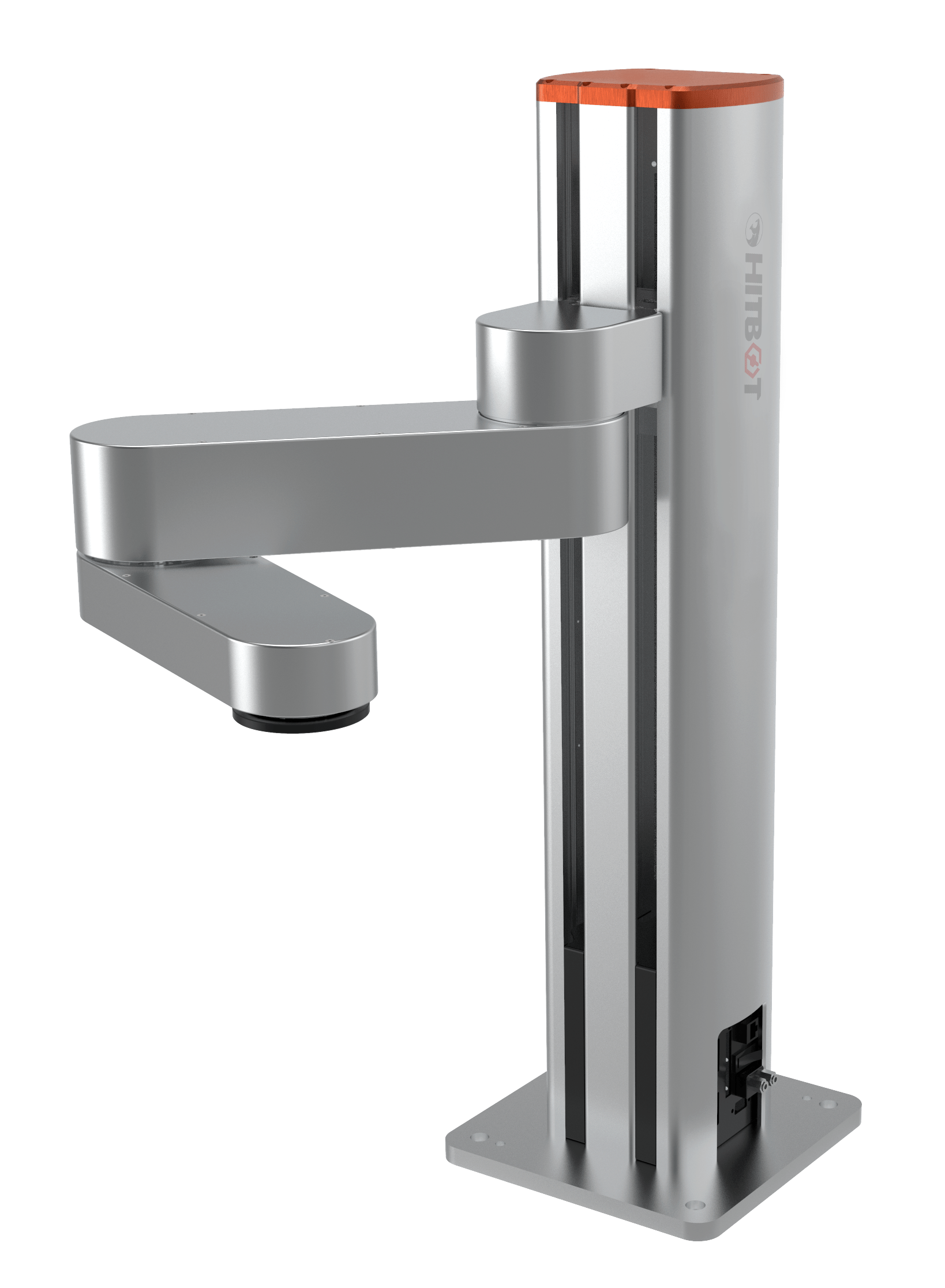
Before diving into control, we must grasp the SCARA’s unique mechanical structure, as it dictates how it can be controlled:
Four Degrees of Freedom (DoF): A typical SCARA has:
Joint 1 (J1): Base rotation (θ1) – Swivels the entire arm horizontally.
Joint 2 (J2): Shoulder rotation (θ2) – Moves the first link relative to the base.
Joint 3 (J3): Prismatic (Linear) Z-axis (d3) – Raises and lowers the end-effector vertically.
Joint 4 (J4): Wrist rotation (θ4) – Rotates the end-effector (tool) about the vertical (Z) axis.
Selective Compliance: The key design feature. The arm is rigid and highly precise in the horizontal (X-Y) plane due to the rotational joints. However, it’s intentionally compliant (slightly flexible) in the vertical (Z) direction. This compliance allows it to absorb small vertical misalignments during insertion tasks (like placing a component on a board) without causing damage or excessive force – crucial for delicate assembly operations.
Serial Linkage: The links are connected serially, meaning movement at one joint affects the position of all subsequent links and the end-effector. This creates complex kinematic relationships.
-
The Brain: The Robot Controller
The central nervous system is the robot controller – a specialized industrial computer. Its core functions are:
Path Planning: Converting the desired task (e.g., “Pick component from A, move smoothly to B, place it”) into a detailed sequence of positions, orientations, velocities, and accelerations for the end-effector in 3D space (Cartesian coordinates – X, Y, Z, and orientation, often Roll/Pitch/Yaw or just Yaw via θ4).
Kinematic Transformation: This is the heart of SCARA control, translating between two fundamental coordinate systems:
Cartesian Space (World/Tool Frame): Where we define where the end-effector should be (X, Y, Z, θ4).
Joint Space (Robot Frame): The actual angles (θ1, θ2) and linear position (d3, θ4) the motors need to achieve.
Servo Control Loop Execution: Continuously commanding the motors to reach and maintain the desired joint positions.
I/O Handling: Communicating with sensors (vision, force/torque), grippers, conveyors, and the broader factory system (PLCs).
Safety Monitoring: Enforcing limits on speed, torque, position, and workspace boundaries.
-
Kinematic Transformation: The Math Magic
This translation between Cartesian and Joint space is where the core intelligence resides. It involves two critical calculations:
Forward Kinematics (FK): Given the joint angles/positions (θ1, θ2, d3, θ4), where is the end-effector?
Uses trigonometric relationships based on the link lengths (L1, L2) and joint positions.
Relatively straightforward calculation.
Used for verifying position, simulation, and some control strategies.
Inverse Kinematics (IK): Where do the joints (θ1, θ2, d3, θ4) need to be to place the end-effector at a specific X, Y, Z, and orientation?
This is the critical calculation for SCARA control. The controller constantly solves IK problems to determine the target joint positions for every point along the planned path.
For SCARA robots, IK is mathematically solvable in closed-form (exact equations exist), making it computationally efficient and highly accurate. This is a significant advantage over robots with more complex kinematics.
Equations involve trigonometry (atan2 function is crucial for correct quadrant handling) and Pythagoras theorem, specifically relating to the planar (X-Y) positioning defined by θ1 and θ2. The Z-axis (d3) and wrist rotation (θ4) are usually straightforward linear/rotational mappings.
-
Servo Control: Muscle Meets Mind
Knowing the target joint positions (from IK) is only half the battle. The motors must get there accurately and quickly. This is the domain of closed-loop servo control:
The Players:
Servo Motor (usually Brushless DC – BLDC): Provides the physical torque to move the joint.
Encoder (or Resolver): Attached to the motor or joint, providing high-resolution feedback on the actual position (and often velocity) of the joint.
Servo Drive (Amplifier): Takes low-power command signals from the controller and delivers the high-power current needed to drive the motor.
Controller (Servo Loop): The algorithm comparing target and actual position/velocity and calculating the corrective action.
The Control Loop (Simplified):
- Measure: The encoder reads the actual joint position (and velocity).
- Compare: The controller calculates the error (Target Position – Actual Position).
- Compute: A control algorithm (most commonly PID Control – Proportional, Integral, Derivative) processes this error:
- Proportional (P): Generates a command proportional to the current error. Bigger error = stronger corrective force. Determines responsiveness.
- Integral (I): Sums past errors over time. Eliminates steady-state error (e.g., holding position against gravity or friction).
- Derivative (D): Predicts future error based on the rate of change of error. Damps oscillations and improves stability, especially during rapid moves.
- Command: The computed PID output (usually a torque or current command) is sent to the servo drive.
- Actuate: The servo drive powers the motor to move the joint, reducing the error.
- Repeat: This cycle happens thousands of times per second (high servo update rate) for each joint motor.
-
Trajectory Generation & Interpolation: Smooth Moves Matter
Control isn’t just about hitting points; it’s about moving between points smoothly, efficiently, and precisely:
- Point-to-Point (PTP): Move from Start to End as fast as possible, path isn’t strictly defined. Used for pure speed where path doesn’t matter.
- Continuous Path (CP) / Coordinated Motion: Essential for SCARA precision tasks. The controller calculates a smooth, continuous path the end-effector will follow between programmed points.
- Interpolation: The mathematical method used to generate intermediate points along the desired path (straight line, circular arc, spline) in Cartesian space.
- Real-time IK: At each tiny time step (dictated by the servo rate), the controller performs IK on the next interpolated Cartesian point to generate the corresponding target joint positions.
- Motion Profiles: Defines how speed and acceleration ramp up and down (e.g., trapezoidal or S-curve profiles). Smooth acceleration/deceleration minimizes vibration, wear, and settling time, and ensures part quality (no dropped components!).
-
Advanced Control Concepts Enhancing SCARA Performance
Modern SCARA controllers leverage additional techniques for even better performance:
Feedforward Control: Anticipates the forces needed to move (inertia, friction, gravity) and injects a command ahead of the PID loop. This significantly reduces following error during high-speed acceleration/deceleration. Think of it as proactive compensation.
Gravity Compensation: Actively calculates and counteracts the torque needed to hold the arm up against gravity at different poses, especially important for the J2 shoulder joint. Prevents position drift and reduces servo effort.
Friction Compensation: Models and counteracts static (stiction) and dynamic friction within the joints and transmissions, improving low-speed smoothness and settling accuracy.
Vibration Damping: Algorithms detect and actively suppress residual vibrations at the end-effector after rapid moves or direction changes, reducing settling time. Crucial for high-throughput applications.
Collision Detection & Force Control (Increasingly Common): Monitoring motor current/torque to detect unexpected collisions or using integrated force/torque sensors to perform delicate insertion tasks or surface following with controlled contact force. This brings SCARAs closer to collaborative applications.
Why Understanding Control Principle of Scara Robot Matters for YOU
Grasping these principles isn’t academic; it translates directly to operational success:
- Informed Selection: Understand why SCARA kinematics excel in planar tasks but might not be ideal for complex 3D paths. Evaluate controller capabilities (servo rate, advanced features like feedforward, force control) based on your speed, precision, and task complexity needs.
- Optimization: Tune servo gains (PID parameters) effectively. Understand how changing motion profiles (acceleration) impacts cycle time and vibration. Utilize gravity/friction compensation settings properly.
- Troubleshooting: Diagnose issues more effectively:
Poor repeatability? Check encoders, mechanical backlash, servo tuning.
Vibration/Overshoot? Check servo tuning (D gain), motion profile aggressiveness, mechanical rigidity.
Slow settling? Investigate vibration damping settings, friction compensation, motion profiles.
Following error? Examine servo tuning (P/I gains), feedforward settings, mechanical binding.
- Programming Efficiency: Understand how path planning and interpolation choices affect cycle time and path accuracy. Utilize coordinated motion effectively.
- Maximizing ROI: Optimizing control parameters and motion profiles directly impacts throughput (parts per minute), quality (reduced defects from vibration or misplacement), and equipment lifespan (reduced wear from harsh movements).
Conclusion: The Symphony of Precision
The control principle of SCARA robot is a remarkable symphony of mechanical design, mathematical computation (especially Inverse Kinematics), high-speed closed-loop servo control, and sophisticated trajectory planning. It’s not magic; it’s meticulously engineered physics and real-time processing working in perfect harmony. From the initial path command in Cartesian space to the thousands of micro-adjustments made by the servo loops every second, every element is focused on achieving that unparalleled combination of speed and precision in the horizontal plane.
By understanding these fundamental principles – the “why” behind the “how” – you move beyond being just an operator to becoming a true optimizer. You gain the knowledge to select the right SCARA for the job, configure it for peak performance, swiftly diagnose issues, and ultimately unlock the full potential of this transformative automation technology on your factory floor. The precision dance of the SCARA is complex, but understanding its steps empowers you to choreograph flawless production.